
Four years after FTX, customers never got their bitcoin back
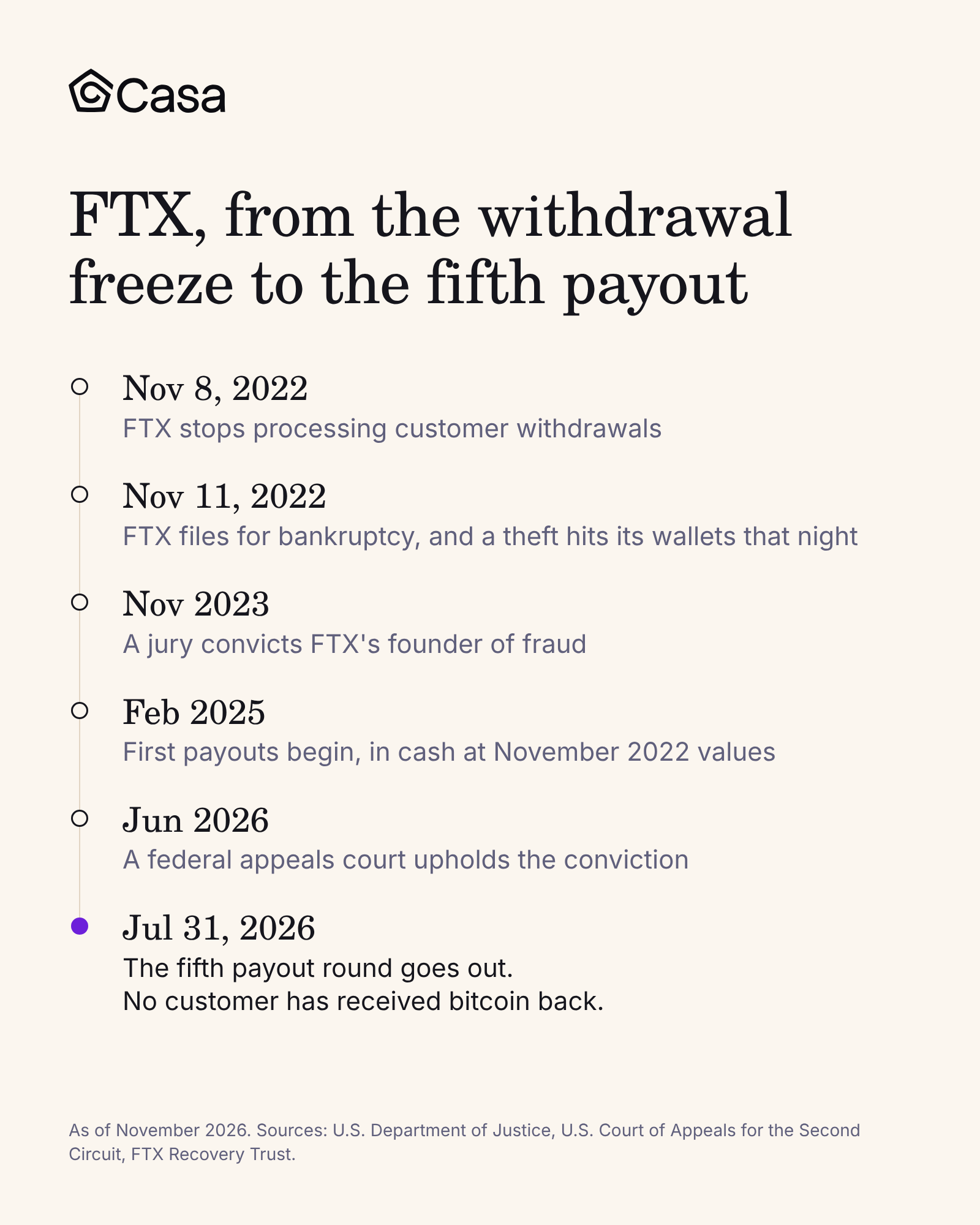
Four years ago this month, FTX stopped processing withdrawals. Customers still had balances on the exchange and no way to move them. Three days later, on November 11, 2022, FTX filed for bankruptcy.
By July 2026, the bankruptcy estate had paid out about $10 billion across five rounds. Every payment was based on what customers' assets were worth the day FTX filed, and no customer got their bitcoin back.
Where FTX stands in 2026
The repayments. The fifth distribution went out on July 31, 2026, and brought the total paid since the filing to about $10 billion. Every claim was valued in dollars as of November 2022.
The theft. The same night FTX filed, more than $400 million in digital assets left its wallets. In January 2024, prosecutors charged three people in a SIM swap scheme that press reports have tied to the theft. A SIM swap is a form of social engineering. One defendant pleaded guilty in May 2024, and as of this writing we haven't found a public outcome for the other two
For anyone holding bitcoin today, the lesson sits in how customers ended up with cash, at 2022 values, for coins they thought were theirs.
FTX told customers their deposits were held for them
FTX's founder told the public that customer deposits "were kept safe and were held in custody for the customers." According to the Justice Department, that was false. He moved billions of dollars in customer deposits to Alameda Research, his trading firm, and spent the money on investments, political donations, and real estate.
Prosecutors put the customer money taken at more than $8 billion.
A custodian makes every decision about your bitcoin
When you buy bitcoin on an exchange and leave it there, the exchange holds the keys. Your account shows a balance, and that balance is the exchange's promise to send you bitcoin when you ask.
Jameson Lopp, Casa's co-founder, has described that arrangement as depending on "a counterparty that can refuse or deny those claims." FTX customers met that counterparty on November 8, when withdrawals stopped.
While an exchange keeps its promises, you can't see the difference between a balance and bitcoin you hold yourself. The difference shows up on the day the exchange can't pay.
FTX customers trusted the exchange's word about their deposits and its security around its wallets. Both failed in the same week, and customers had no say in either one. With a custodian, every decision about your bitcoin belongs to someone else, including the ones that go wrong.
 Team Casa

FTX customers got cash at November 2022 prices
In bankruptcy, customers became creditors. FTX's repayment plan converted every claim for digital assets into cash, valued at prices on the day FTX filed. Each bitcoin on the exchange counted as $16,871.
Payments went out in five rounds between February 2025 and July 2026. The smallest claims, which the plan calls convenience claims, received 120% of their dollar value, and larger claims came in installments.
None of those payments were bitcoin. A customer who had one bitcoin on FTX received a dollar amount pegged to its value on the filing date. Customers never got to decide whether to sell or keep holding, because the bankruptcy made that decision for them.
Holding your own keys removes the claim
Self-custody means you hold the keys that control your bitcoin, on a device and in a backup you control. No exchange stands between you and the coins, so an exchange's bankruptcy doesn't reach bitcoin it never held.
For many bitcoiners, self-custody starts with a hardware wallet. The device generates your keys and gives you a seed phrase, a list of words that can restore them if the device breaks or goes missing. Moving bitcoin onto it is a withdrawal from the exchange to an address your wallet provides, and many people send a small test amount first to confirm it arrives.
Self-custody also moves the responsibility to you. With a single hardware wallet, anyone who obtains the seed phrase can move the funds, with no second key required. That makes your seed phrase backup as important as the device itself.
Singlesig + passphrase adds a passphrase that someone holding your seed phrase would also need. Singlesig remains a reasonable choice for many bitcoiners, particularly for smaller balances. As the amount you're protecting grows, so does the value of reducing single points of failure.
A multisig wallet like a 3-key vault requires two of three keys to spend, and the keys live on separate devices in separate places. The loss or theft of one key alone doesn't give someone access to your funds, and it doesn't prevent recovery with the other two.
Four years on, the FTX story lives mostly in court rulings and payout schedules. For its customers, the ending was a dollar figure fixed on the day the exchange filed, and the decision about their bitcoin was never theirs to make.
When someone else holds your keys, their failure becomes yours.
Four years ago today, FTX filed for bankruptcy.
— Casa (@CasaHODL) November 11, 2026
Customer claims were valued at November 2022 prices, about $16,871 per bitcoin.
People who held bitcoin there are being repaid in dollars, not bitcoin.
When someone else holds your keys, their failure becomes yours. pic.twitter.com/i5sBkJjB57
Questions about FTX in 2026
Did FTX customers get their bitcoin back?
No. FTX's repayment plan converted every claim for digital assets into cash, valued at prices on November 11, 2022, the day FTX filed for bankruptcy.
How much have FTX customers been repaid?
By July 2026, the bankruptcy estate had paid out about $10 billion across five rounds. Convenience claims, the smallest class, received 120% of their dollar value.
What happened in the FTX hack?
The night FTX filed, more than $400 million in digital assets left its wallets. In January 2024, prosecutors charged three people in a SIM swap scheme that press reports have tied to the theft.
How do you move bitcoin off an exchange?
You withdraw it to an address from a wallet where you hold the keys, such as a hardware wallet. Many people send a small test amount first to confirm it arrives.